Log in
 Contact Us





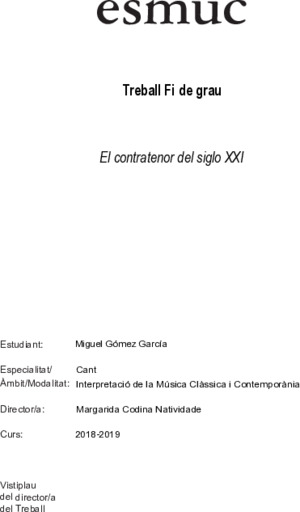
El contratenor del siglo XXI
| dc.contributor | Escola Superior de Música de Catalunya | |
| dc.contributor | Codina Natividade, Margarida | |
| dc.contributor.author | Gómez García, Miguel | |
| dc.date.accessioned | 2020-04-27T17:38:24Z | |
| dc.date.accessioned | 2025-03-14T11:28:03Z | |
| dc.date.available | 2020-04-27T17:38:24Z | |
| dc.date.available | 2025-03-14T11:28:03Z | |
| dc.date.created | 2019-06 | |
| dc.date.issued | 2019-06 | |
| dc.identifier.uri | http://hdl.handle.net/20.500.12694/7253 | |
| dc.description | El treball i els resums d’aquesta pàgina han estat elaborats per l’autor/a, que n’assumeix íntegrament la responsabilitat de redacció i revisió. | |
| dc.description.abstract | En l'actualitat assistim a una veritable època daurada de la veu de contratenor. No obstant això, existeixen especificitats i normes no escrites pel que fa al tipus de repertori que habitualment canta i al codi estètic que utilitza. Mitjançant una perspectiva del darrer segle, indiquem els factors més importants que han portat a la imatge actual del contratenor, des de l'emancipació dels male altos dels cors catedralicis anglesos fins als avenços en l'ampliació del repertori i les capacitats vocals dels cantants amb carreres internacionals de la nostra generació, passant per la reapropiació del terme “contratenor”, que remet a un determinat moment històric i que serveix a la vegada per justificar la seva existència actual i per començar a formar una base del repertori que li és propi. | ca |
| dc.description.abstract | En la actualidad asistimos a una verdadera edad de oro de la voz de contratenor; sin embargo, existen especificidades y normas no escritas con respecto al tipo de repertorio que habitualmente canta y al código estético que utiliza. Mediante una perspectiva del último siglo, indicamos los factores más importantes que han llevado a la imagen actual del contratenor, desde la emancipación de los male altos de los coros catedralicios ingleses hasta los avances en la ampliación del repertorio y las capacidades vocales de los cantantes con carreras internacionales de nuestra generación, pasando por la reapropiación del término “contratenor”, que remite a un determinado momento histórico y que sirve a la vez para justificar su existencia actual y para comenzar a formar una base del repertorio que le es propio. | spa |
| dc.description.abstract | Currently, we are witnessing a true golden age of countertenor voices; however, there are specificities and unwritten rules related to the kind of repertoire they usually sing and the aesthetic code they follow. From a perspective spanning the last century, we highlight the most important factors that have shaped the current image of the countertenor, from the emancipation of the male alto from English cathedral choirs to the progress in the fields of new repertoire and technical vocal achievements of the most recent generation of voices. One of the highlights of this process is the reappropriation of the term “countertenor,” which refers to a specific historical moment and both justifies its current use and establishes the foundation of its own repertoire. | eng |
| dc.format.extent | 78 p. | cat |
| dc.language.iso | spa | cat |
| dc.rights | Attribution-NonCommercial-NoDerivatives 4.0 International | |
| dc.rights.uri | http://creativecommons.org/licenses/by-nc-nd/4.0/ | |
| dc.subject.other | TFG Música clàssica i contemporània | |
| dc.title | El contratenor del siglo XXI | |
| dc.type | info:eu-repo/semantics/bachelorThesis | cat |
| dc.rights.accessLevel | info:eu-repo/semantics/openAccess | |
| dc.embargo.terms | cap | cat |
| dc.subject.lemac | Contratenors--S. XXI | |
| dc.subject.lemac | Contratenors--Estètica | |
| dc.subject.lemac | Cantants--Història i crítica |
Files in this item
This item appears in the following Collection(s)
-
ESM sèrie - TFG [302]
Treballs finals de grau (TFG) de l'ESMUC

Except where otherwise noted, this item's license is described as http://creativecommons.org/licenses/by-nc-nd/4.0/
Related Items
Displaying related items by Title and Subject.
-
El tenor sui generis: dos tenores rossinianos
(2015-07-14)Aquest projecte estudia la trajectòria i les característiques de dos tenors de l'època de Rossini: Andrea Nozzari i Giovanni David. Tots dos van participar en l'estrena d'òperes com Otello i La donna ...Este proyecto estudia la trayectoria y las características de dos tenores de la ópera de Rossini: Andrea Nozzari y Giovanni David. Ambos participaron en el estreno de óperas como Otello y La donna del ...This project studies the trajectory and characteristics of two tenors from Rossini’s operas: Andrea Nozzari and Giovanni David. Both performed in operas including Otello and La donna del lago throughout ... -
Aportacions tímbriques de la guitarra elèctrica en un context orquestral: la guitarra elèctrica a la composició contemporània
(2019-06)“Aportacions tímbricas de la guitarra elèctrica en un context orquestral” és un recorregut per la història de la guitarra elèctrica des dels seus orígens fins a l'actualitat, a través de les revolucions ...“Aportaciones tímbricas de la guitarra eléctrica en un contexto orquestal” es un recorrido por la historia de la guitarra eléctrica desde sus inicios hasta la actualidad, a través de las revoluciones ...“Timbric Contributions of the Electric Guitar in an Orchestral Context” traces the history of the electric guitar from its origins to the present, highlighting the technological and social revolutions ... -
Veus andrògines? La performance musical com a creadora d'identitats de gènere en els contratenors actuals
(2019-06)Aquest treball té la intenció d'explorar el concepte de performance musical, entesa des d'un punt de vista el més ampli possible, com a creadora d'identitats de gènere. El centre d'aquest treball és un ...Este trabajo tiene la intención de explorar el concepto de performance musical, entendido desde un punto de vista lo más amplio posible, como creadora de identidades de género. El centro de este trabajo ...In this undergraduate dissertation, I want to explore the concept of musical performance in its widest sense as a creator of gender identities. The core of this dissertation is a case study of four ...